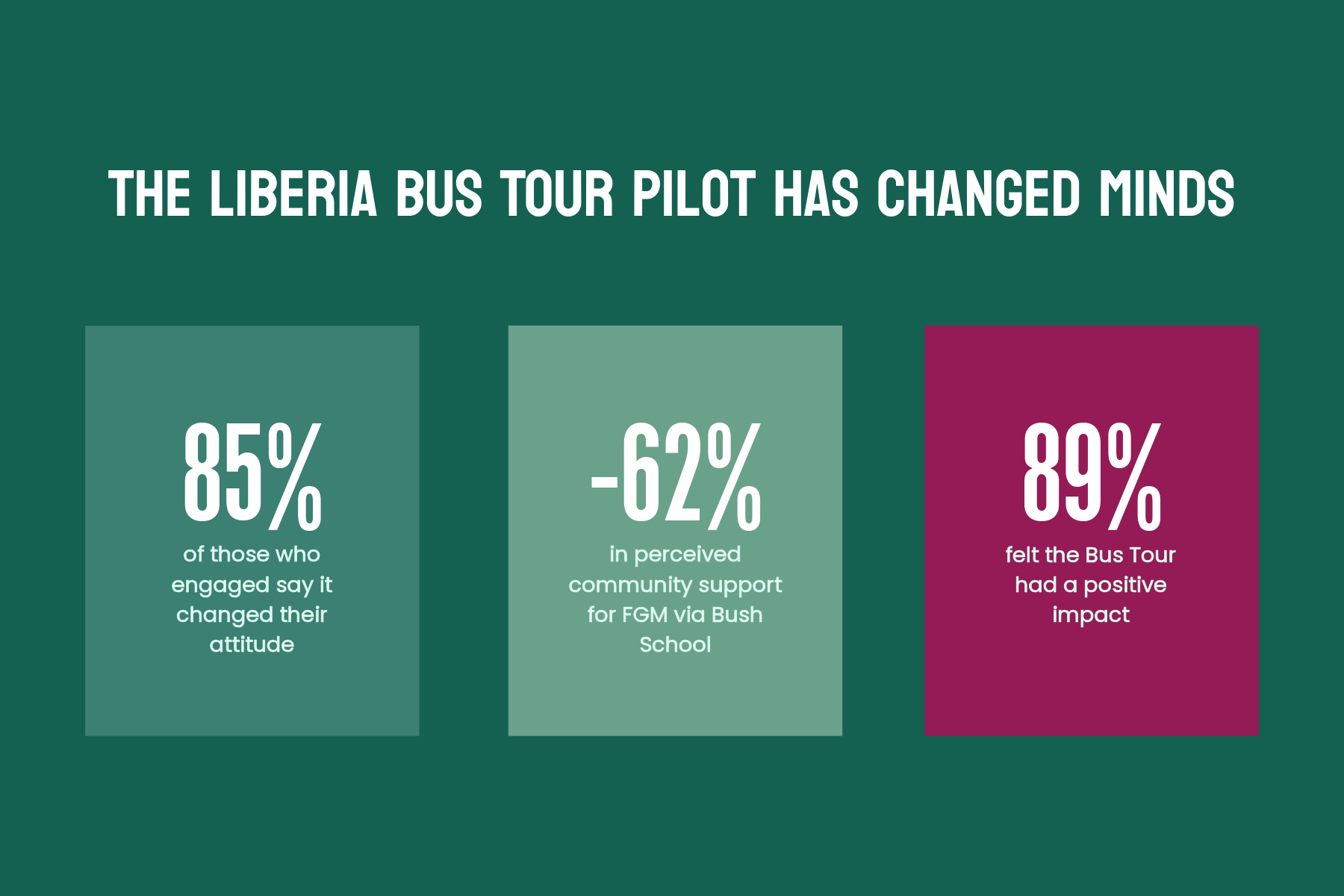
The Liberia Born Perfect Bus Tour Pilot shows that frontline, locally led interventions can rapidly reduce support for FGM and drive measurable behaviour change at community level. Baseline and endline studies in Bong and Gbarpolu counties found that 85% of those who engaged said the campaign changed their minds about FGM, alongside a 73% reduction in intention to send daughters to the Bush School. These results provide strong evidence that targeted, community-led approaches can accelerate FGM abandonment in high-prevalence settings.
Funded by Irish Aid and UN Women in Liberia, and led by frontline organisation Medica Liberia, the Bus Tour launched on Zero Tolerance Day, 6th February 2026, traveling from village to village with religious leaders, ex-cutters, cultural influencers, survivors, and activists, to deliver religious, medical, and legal messaging for FGM abandonment. The caravans reached deeply into practising communities, with over half (54%) aware of the campaign and 4 in 10 directly engaging. Variations in engagement levels reflected local operating conditions – particularly higher population mobility in transit areas such as Bong County – rather than the strength of the model itself. Among those who engaged, 89% said the Bus Tour had a positive impact, and 3 in 4 said they learned something new, demonstrating strong message penetration even in remote areas.
The data shows clear, statistically significant shifts in attitudes and social norms around FGM. Resistance to the Bush School increased, with the belief that it is “fine as it is” dropping by 80%, alongside a 74% drop in perceived community support for the practice and a 40% increase in support for removing FGM initation from the Bush School. The data also shows which messages influenced attitudinal change; agreement that girls are “born perfect” rose by 65%, while understanding of the physical and mental harms and human rights violations of FGM also increased. The pilot study also shows early signs of sustained behavioural change, with increased family and community conversations about FGM and more people actively deciding not to cut their daughters. It also generated important operational insights for scale – highlighting the importance of local media and tailored mobilisation to local contexts. Overall, the findings provide a strong evidence base for scaling the model, demonstrating that frontline-led, community-based campaigns can deliver tangible, cost-effective progress towards ending FGM.