On May 23rd 2026, it will be ten years since 51 signatories came together at the World Humanitarian Summit in Istanbul to agree a deal that was meant to transform the aid system: the Grand Bargain.
At its core, the Grand Bargain aid commitment was simple. The world’s biggest donors and international organisations pledged to move more funding directly to frontline organisations—those closest to communities—rather than through layers of intermediaries.
Ten years on, that promise remains largely unmet.
What Was the Grand Bargain Aid Commitment?
When the Grand Bargain was agreed in 2016, major donor governments—including the US, Germany, and Japan—joined leading international NGOs such as World Vision, Save the Children, and CARE International.
They committed to increasing the share of humanitarian funding going “as directly as possible” to local and national organisations—from less than 3% to at least 25%.
At the time, this was seen as a turning point for the aid system.
But in 2026, the reality is stark: less than 3% of funding still reaches frontline organisations directly.
Why Grand Bargain Aid Failed to Deliver
Despite widespread agreement, the structure of the aid system barely changed.
Funding continued to pass through:
⦿ Large international NGOs
⦿ UN agencies
⦿ Private consultancies
Each layer added cost, complexity, and distance from the communities the funding was meant to serve.
In many cases, significant resources were absorbed before reaching the frontline. As one senior UK Foreign Office official put it, there has been a long-standing reluctance to trust local, women-led organisations—despite evidence that they deliver stronger results and better value for money.
Ten years after the Grand Bargain, the system remains largely intact.

The 2026 Development Aid Crisis
The failure of Grand Bargain aid reform is now colliding with a major global funding crisis.
In 2026, development funding has been cut by an estimated $50 to $70 billion annually, driven by:
⦿ The closure of USAID programmes
⦿ The diversion of European funding to conflicts in Ukraine and the Middle East
This has forced donors to confront a difficult reality: the current model is expensive, inefficient, and increasingly unsustainable.
A Turning Point for Frontline Organisations?
For the first time in a decade, there are signs that change may finally be happening.
With shrinking budgets, donors are under pressure to deliver more impact with fewer resources. And the evidence is clear: frontline organisations—especially those led by women—consistently deliver better value for money.
Recent developments suggest a shift:
- Save the Children has announced plans to step back from certain UN pooled funding mechanisms
- Norway has introduced new localisation initiatives
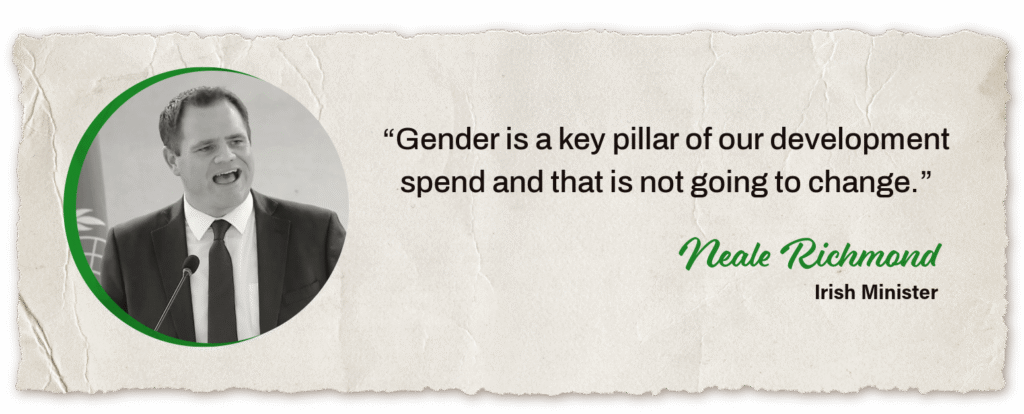
- Donors such as Ireland and Iceland continue to prioritise direct funding to local organisations
These are early and cautious steps—but they signal a growing recognition that the current system is not working.
New Funding Models: Cutting Out the Middlemen
At the philanthropic level, new approaches are emerging to address the failures of Grand Bargain aid.
The Wallace Global Fund is establishing a dedicated pooled fund to channel resources directly to frontline organisations working to end FGM. The model invites governments to collaborate directly with grassroots activists on funding decisions.
To ensure accountability, funds will be managed through a fiscal partner, Women Win, providing robust financial oversight while keeping decision-making close to the frontline.
This approach aims to do what the Grand Bargain promised—but did not deliver: get funding directly to those doing the work.
Demand Far Outstrips Supply
The need for direct funding has never been clearer.
The UN Women Trust Fund—one of the few mechanisms prioritising frontline organisations—received:
- 3,925 applications
- From 128 countries
- Requesting over $2.1 billion
Yet in 2026, it was only able to distribute $16 million.
This gap highlights a critical issue: frontline organisations are ready to deliver—but lack the resources to do so.
Why This Matters for Ending FGM
For issues like Female Genital Mutilation, the implications are significant.
Decades of evidence show that locally led, frontline interventions are the most effective way to drive behaviour change and protect girls.
Yet these same organisations continue to receive only a fraction of global funding.
If donors are serious about ending FGM, shifting resources to frontline women is not optional—it is essential.
10 Years On, 3% Is Not Enough
Ten years after the Grand Bargain, the central question remains:
Will donors finally act on what they already know?
With funding shrinking and pressure increasing, there is now a real opportunity to rethink how aid is delivered—moving away from costly intermediaries and towards direct, locally led solutions.
On June 23rd, the Wallace Global Fund will call on donors to increase the share of funding reaching frontline organisations.
The solutions exist. The evidence is clear.
The question is no longer whether change is possible—but whether the system is ready to let it happen.